On 11 May 973, King Edgar was rowed on the River Dee at Chester by tributary kings pledging allegiance, an event that symbolised his overlordship of Britain. Today, Edgar's Field in Handbridge stands as the enduring site of this historic council.
The Council of 973: A Display of Unity
King Edgar had already ruled England for fourteen years when he was formally crowned at Bath in 973. Weeks later, he convened a council at his royal residence in Chester, traditionally believed to have been sited at what is now Edgar's Field in Handbridge. The event drew monarchs from across Britain who came to acknowledge Edgar's authority.
Contemporary records from the Anglo-Saxon Chronicle note that six kings pledged their allegiance to Edgar at Chester. These included Kenneth II of Scotland, Máel Coluim I of Strathclyde, and five Welsh kings. Following the council, Edgar granted Laudian, thought to be Lothian, to Kenneth II, a move that shifted the Anglo-Scottish border northward in Scotland's favour.
Later medieval chroniclers embellished the story. By the twelfth century, accounts claimed that eight tributary kings had rowed Edgar in a state barge from his residence at Edgar's Field up the River Dee to the Minster Church of St John the Baptist on the north bank. While contemporary sources do not confirm this detail, the legend has endured as part of Chester's historical identity.
Edgar's Field: Location and Access
Edgar's Field is a 2.25-acre public park situated in Handbridge, immediately south of the River Dee. The park sits adjacent to Greenway Street, a location long associated with Chester's fishing community. Visitors can reach the site on foot via the Old Dee Bridge from the city centre, across the Queen's Park Suspension Bridge from The Groves, or by Grosvenor Bridge.
The park occupies the site of a former sandstone quarry that likely supplied material for Chester's city walls and buildings during Roman and medieval times. Today, the park is designated as a Regionally Important Geodiversity Site for its distinctive sandstone geology. From the park, visitors enjoy unobstructed views of the River Dee, the Old Dee Bridge, Chester's city walls, and Grosvenor Bridge.
The Roman Minerva Shrine
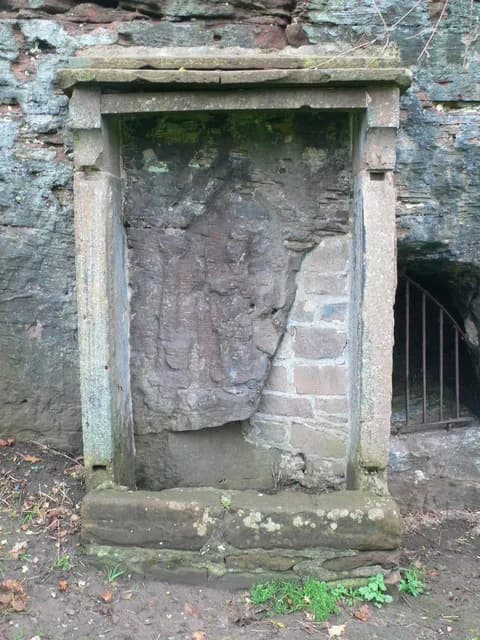
The most significant feature within Edgar's Field is the Roman Minerva Shrine, carved directly into the sandstone outcrop. This is the only rock-cut Roman shrine still in its original position in Western Europe, and it holds Grade I listed status.
The shrine depicts the goddess Minerva, patron of soldiers, craftsmen, and travellers, holding a spear in her right hand with an owl above her right shoulder symbolising wisdom. The carving measures approximately four feet nine inches tall by two feet six inches wide. The relief is heavily weathered, with additional pit marks caused by accidental rifle practice during the Second World War.
Historians believe the shrine survived the medieval period because it was mistaken for an image of the Virgin Mary. Adjacent to the carving is Edgar's Cave, a natural fissure in the rock that was enlarged after the shrine was cut. Some scholars suggest this cave may have been used for offerings in Roman times, particularly to invoke protection during crossings of the River Dee at the nearby ford.
What Remains Uncertain
No archaeological evidence has been found to confirm that Edgar's royal palace stood at Edgar's Field, though the tradition is well-attested in later medieval accounts. Similarly, the precise number of kings who attended the 973 council, and whether they actually rowed Edgar's barge, remains disputed between sources.
Preservation and Community Effort
The park and its historic features have benefited from the work of the Friends of Edgar's Field, a local volunteer group. In the summer of 2010, the group carried out repairs to the Minerva Shrine, installed new play area equipment, and conducted tree maintenance. An earlier information board explaining the shrine's history was vandalised, though replacements were planned.
Edgar's Reign: A Golden Age
The 973 council at Chester took place during what historians regard as a golden age of Anglo-Saxon culture. Edgar's reign, from 959 to 975, was marked by the absence of Viking invasions, strong support for Benedictine monastic reform, and administrative advances including the standardisation of coinage. The coronation at Bath and the subsequent council at Chester reinforced his position as ruler of a unified England and overlord of Britain.
For Chester residents and visitors today, Edgar's Field offers a tangible connection to this pivotal moment in British history, standing where kings once gathered and legends took root.