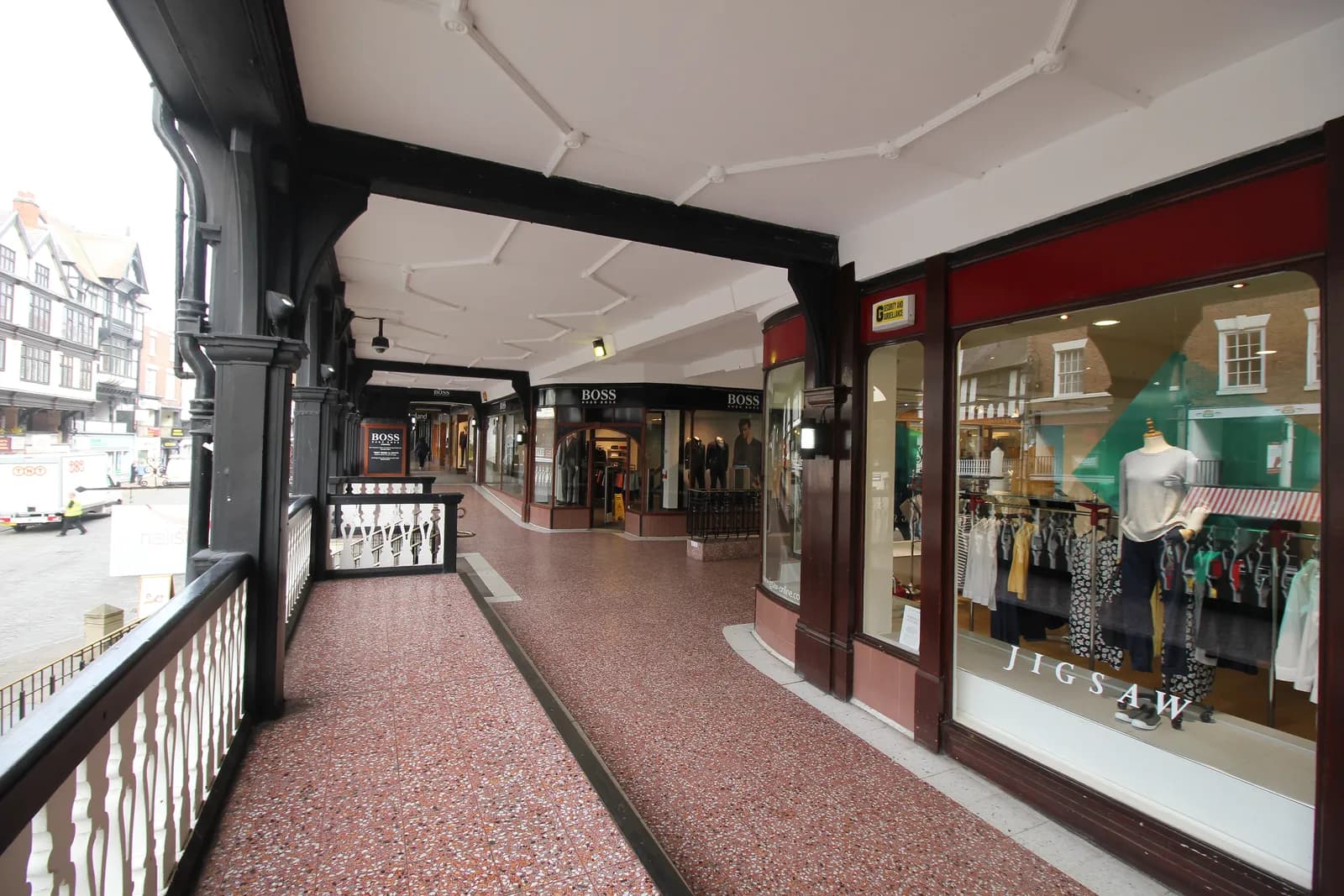
The Chester Rows constitute a unique architectural feature found nowhere else in Britain. These covered, two-tier medieval walkways, which have served as shopping galleries for approximately 700 years, continue to function as commercial thoroughfares in the heart of Chester today.
A Unique Architectural System
The Rows consist of continuous covered walkways on the first floor, running behind which are entrances to shops and other premises. At street level, another set of shops and premises exists, with many entered by descending a few steps. The storey above the first-floor walkway overlaps it, creating the covered gallery that defines the Row. On the street side, railings and display areas historically served as shelves or stalls for merchants' goods.
The system extends throughout the streets radiating from Chester Cross: Watergate Street, Northgate Street, Eastgate Street, and Upper Bridge Street. The Rows are continuous on both sides of Upper Bridge Street, along most of Watergate and Eastgate Street, and for a shorter stretch on the east side of Northgate Street. Lower Bridge Street once featured Rows as well, though these were enclosed during the 17th and 18th centuries.
Origins and Development
The precise origins of the Rows remain uncertain, though dendrochronological evidence indicates they date back to the 13th century. The first documented reference appears in 1293, though scholars debate whether this refers to the Rows as they exist today. The earliest unambiguous use of the term to describe an elevated walkway dates from 1356. By approximately 1350, the system had largely reached its full extent.
One theory connects the Rows to Roman ruins. Rubble from Roman buildings that had fallen into ruin was piled alongside the streets, and medieval structures were later built atop this debris. Another theory links the Rows to the Great Fire of 1278, which destroyed almost the entire town within the walls. Following this catastrophe, owners may have been ordered to construct fireproof stone-lined undercrofts at ground level, with the elevated walkways developing as a consequence.
The undercrofts, or crypts, beneath Row buildings were constructed from stone, while the buildings themselves are predominantly timber. Around 20 stone undercrofts still survive, some featuring vaulted ceilings and dating from the 13th or early 14th century. At the Row level, however, little medieval fabric remains.
Historical Descriptions
The Rows have attracted comment from travellers and writers for centuries. Daniel Defoe, writing in A Tour Through the Whole Island of Great Britain between 1724 and 1726, described them as "long galleries, up one pair of stairs, which run along the side of the streets, before all the houses, though joined to them."
In 1862, George Borrow offered a different interpretation in Wild Wales, claiming: "These rows, which you ascend by stairs up narrow passages, were originally built for the security of the wares of the principal merchants against the Welsh."
Notable Structures
Three Old Arches at 48 Bridge Street holds particular significance. The stone frontage at street and Row levels is considered the earliest surviving shop front in England, dating from the 13th century with an inscription reading "1274 AD". The building contains the largest stone-walled hall set parallel with the Row in Chester, measuring over 12 metres by over 8 metres.
Other notable examples include Cowper House at No. 12 Bridge Street, which features an undercroft of six bays built in sandstone rubble with plain rib-vaulting. Crypt Chambers at No. 28 Eastgate Street possesses a four-bay undercroft, with a department store now occupying the street and Row levels. Bishop Lloyd's House in Watergate Street combines a ground-floor shop with meeting rooms and the Chester Civic Trust office above.
Preservation and Heritage Status
The Rows hold substantial heritage protection. According to the National Heritage List for England, at least 95 buildings containing sections of the Rows are listed: 9 as Grade I, 20 as Grade II*, and 66 as Grade II. This extensive listing reflects their architectural and historical importance.
In July 2010, Chester Rows were announced as a candidate for the United Kingdom Tentative List for World Heritage status. This followed a campaign pledge by local MP Samantha Dixon during the 2022 City of Chester by-election. Visit Chester describes the Rows as "world-famous, 700-year-old galleried walkways" and states that "there is nothing quite like them anywhere else in the world."
The Rows Today
Contemporary premises at street and Row levels serve various purposes. Most function as shops, though offices, restaurants, cafés, and meeting rooms also occupy the galleries. Visitors can browse independent boutiques, well-known retailers, and hidden finds across the two levels.
Since 1995, a pedestrianisation scheme has improved access to the Rows. Most vehicles are prohibited from using the area between 08:00 and 18:00, though unloading is permitted until 10:30 and from 16:30.
Some modern buildings have retained the Row tradition in their designs, including structures in Watergate Street constructed in the 1960s. Historical architects also maintained this continuity, with examples including Booth Mansion of 1700 in Watergate Street and T. M. Penson's Gothic Revival Crypt Chambers of 1858 in Eastgate Street.
The Chester Rows remain one of the city's principal tourist attractions, drawing visitors who seek to experience this singular medieval shopping gallery system that has adapted to serve commerce for seven centuries.