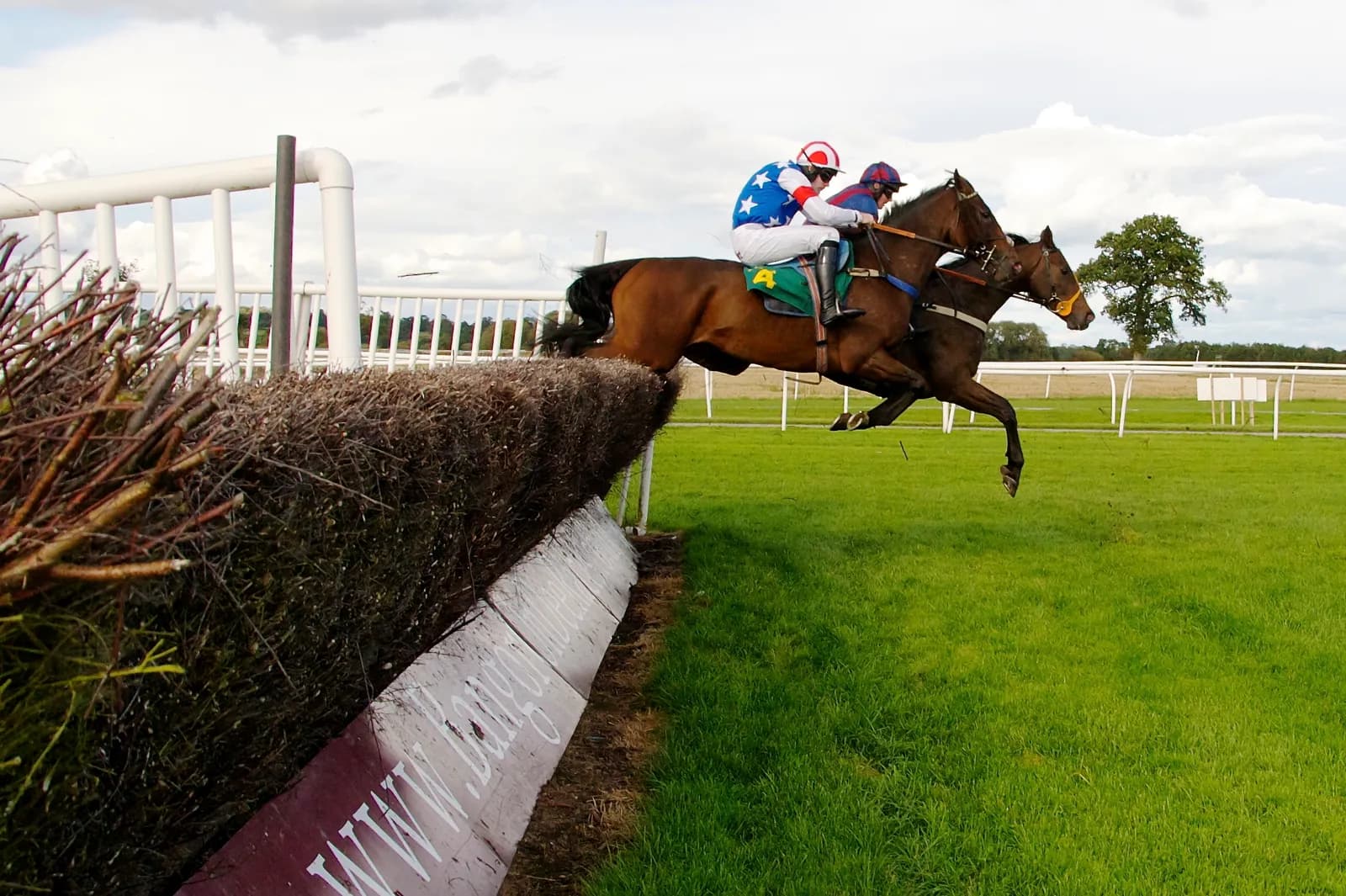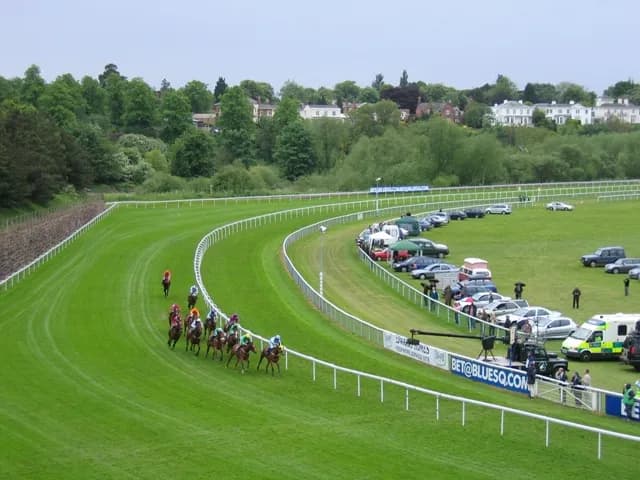
Chester Racecourse holds the Guinness World Record as the oldest operational racecourse still in use, with racing on the Roodee dating back to 1539. The 65-acre course occupies the banks of the River Dee on land once home to a bustling Roman and medieval harbour.
From Harbour to Horse Racing
The Roodee takes its name from "Rood Eye", meaning "The Island of the Cross". This flat expanse of land formed as the River Dee silted up over centuries, rendering Chester's once-thriving medieval port unnavigable for trading vessels.
In 1195, the monk Lucian recorded ships from Aquitaine, Spain, Ireland and Germany unloading wine and merchandise at Chester's harbour. By the mid-16th century, the port was importing vast quantities of fur and skins; a single ship in 1543 brought 1,600 sheep fells, 68 deer, 69 fawn skins and 6,300 badger skins. As the estuary silted, trade shifted downstream to Neston, Parkgate and Hoylake. The port declined seriously from 1762 onwards and could no longer compete with Liverpool by 1840.
The only curious physical reminder of this maritime past stands at the centre of the racecourse: a stone cross with visible marks of water ripples etched into its surface. Legend holds that the cross marks where a statue of the Virgin Mary fell and killed Lady Trawst; the statue was subsequently tried by a jury of twelve men, possibly the first recorded jury trial. Alternative accounts suggest it marks the boundary of a Benedictine Nunnery established in the mid-12th century and dissolved in January 1540.
The Birth of Racing
Horse racing in Chester began in 1539, though some sources cite 1511 or 1512. The first recorded race took place on 9 February 1539, with the consent of Mayor Henry Gee. His surname is said to be the origin of the term "gee-gee" for horses.
Racing replaced the violent Goteddsday (Shrove Tuesday) football match, which Mayor Henry Gee banned in 1533. Races originally took place on Shrove Tuesday until 1609, then moved to St George's Day. Victors received the "Chester Bells", three decorative bells for the horse's bridle, awarded to horses winning five times round the roody.
In 1744, the "Grosvenor Gold Cup" (initially solid gold, later silver) was introduced. The meeting expanded to four days with one race each day from 1745. The May Festival began in 1766, and the Tradesmen's Cup Race, predecessor to today's Chester Cup, started in 1824.
The Course Today
Chester Racecourse is unique in several respects. At just over one mile long with a straight of only 239 yards, it is possibly the smallest significant racecourse in England. The flat, left-handed course runs anti-clockwise, with the east side abutting directly onto Chester's ancient city walls. Spectators can watch races free of charge from the walls, a tradition unchanged for centuries.
The course lies in the shadow of the Grosvenor Bridge, opened in 1833 and once the world's longest single-arch bridge. The North Wales Coast Line railway bridge crosses the River Dee along the northern boundary. Across the river, the mansions of Curzon Park overlook the track.
The first grandstand was completed in 1817, with the first admission fee charged in 1897. The grandstand was rebuilt between 1899 and 1900, destroyed by arson in 1985, and replaced with a new structure that opened in May 1988. Restaurant 1539, named for racing's inaugural year, opened in 2008. The White Horse pub and restaurant opened in the centre of the course in 2013.
Notable Races and Moments
The Chester Cup, a handicap over two miles and two furlongs, celebrated its 200th running in 2024, when Zoffee won with jockey Harry Davies. A record 86 entries were confirmed for the 2026 running, surpassing the previous high of 56 set in 1998.
The Chester Vase, a Group 3 race over one mile and four furlongs for three-year-olds, has served as a trial for the Epsom Derby since its inception. Shergar won the Chester Vase in 1981 before taking the Epsom Derby by ten lengths; the horse was stolen by masked gunmen in 1983. Enable won the Cheshire Oaks in 2017 before claiming the Epsom Oaks, Irish Oaks, King George VI and Queen Elizabeth Stakes, Yorkshire Oaks and Prix de l'Arc de Triomphe.
In 2023, Saffie Osborne became the first female jockey to win the Chester Cup, riding Metier to victory. The racecourse has hosted royalty: Queen Elizabeth II visited in May 1966, when her horse Garter competed in the Cheshire Oaks.
Racing paused only three times in nearly five centuries: during the English Civil War, the First World War and the Second World War. Record attendance was set on Chester Cup Day in 1946, when 103,933 spectators packed the Roodee.
Modern Operations
Chester Racecourse now hosts 15 fixtures per season and welcomes over 333,000 guests annually. The venue has received the ROA Gold Standard Award year after year. It is owned by Chester Race Company Ltd, which also operates Bangor-on-Dee and Musselburgh racecourses, along with the Horseradish catering company, the Holiday Inn Express sister hotel and the Commonhall Social bar in the city centre.
The racecourse has diversified beyond racing. The Boodles May Festival remains a highlight of the flat racing calendar, but the venue now hosts concerts and events. Tom Jones and Nile Rodgers & Chic are scheduled to perform on 14 August 2026. The Olympic torch visited in 2012, carried by jockey Jason Maguire.
In 2026, the racecourse introduced reusable cups across all outlets to reduce single-use plastic. The chesterBET betting system, introduced in May 2012, replaced all former Tote positions.